
A queue forming just beyond a bend. A cyclist heading into a busy junction as traffic speeds up. On most European roads, systems register dangers like these only once they have already formed. A new EU-funded research project, PROSAFE-TWIN, aims to give road operators an earlier warning.
Backed by nearly €5 million from Horizon Europe, the EU’s research and innovation programme, PROSAFE-TWIN brings together 17 organisations from nine European countries and the United States. Coordinated by the Mobility and Logistics Cluster of Euskadi (MLC), the consortium met in Bilbao on 20–21 October to begin 42 months of work, running until March 2030.
A virtual copy of the road that looks ahead
The project is building hybrid digital twins: virtual replicas of real road networks. They combine the physics of how traffic moves with artificial intelligence that learns from roadside sensors, connected vehicles and weather data. The aim is a live risk map showing where dangerous situations, such as hidden queues or conflicts with pedestrians and cyclists, are likely to develop next.
Crucially, the system is designed to say how sure it is. Each prediction will come with a confidence level, so operators can tell a genuine threat from statistical noise and avoid the alert fatigue that undermines many warning systems.
“PROSAFE-TWIN is about moving road safety from reaction to prevention, giving road authorities the intelligence to identify risks and intervene before critical situations become crashes,” said Sofía López de Aguileta at the Mobility and Logistics Cluster of Euskadi (MLC), which coordinates the project and leads the Bizkaia pilot. “What makes this project especially exciting is the combination of expertise and real-world environments behind it.”
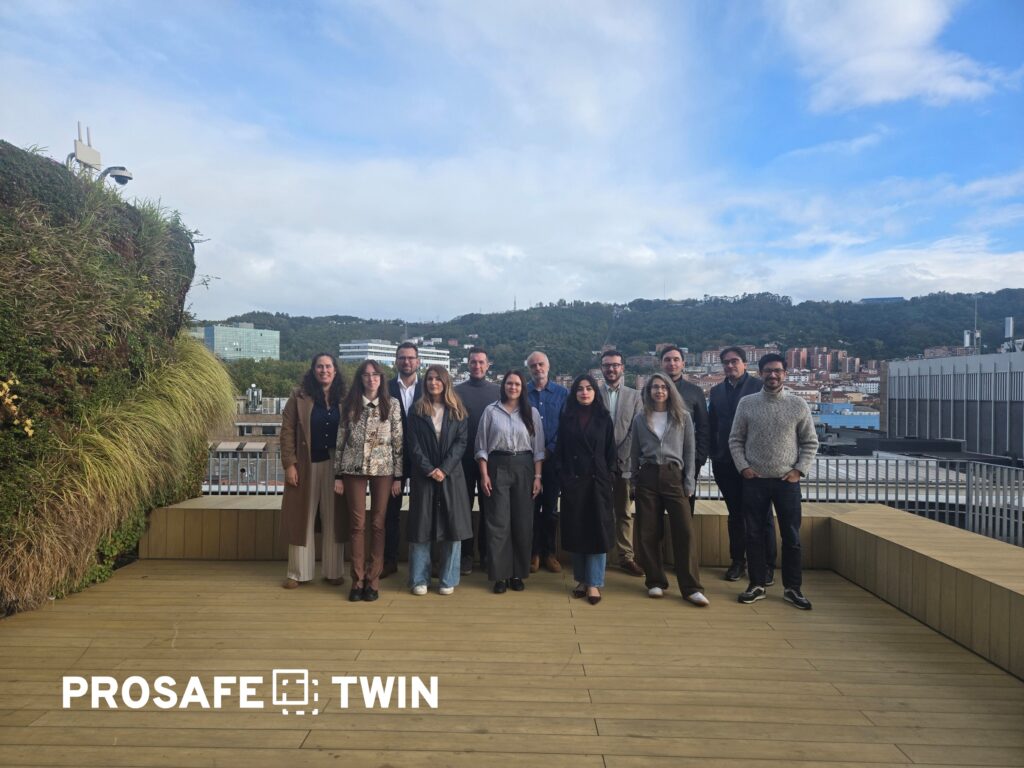
Representatives of the consortium that gathered on October 21 in Bilbao.
Technology alone cannot make roads safer. PROSAFE-TWIN is built to support the judgement of traffic operators, not replace it, and its social scientists will work with operators on how warnings are presented in control rooms. The project will also examine whether AI-supported decisions protect all road users fairly, with particular attention to pedestrians, cyclists and other vulnerable groups.
Four countries, four very different roads
- Bizkaia, Spain: around 600 km of rural and interurban roads, building on the Basque Country Corridor living lab and its connected-vehicle infrastructure.
- Rotterdam, the Netherlands: busy 30–50 km/h city streets shared by cyclists, light electric vehicles, trucks and cars. The city has used an AI-based traffic safety prediction model since 2019, which the project aims to take further.
- Vila Real, Portugal: a 4.2 km stretch of our A4 Trasmontana highway, including the 2.8 km Corgo Viaduct. Here the focus is on spotting high-risk segments and near-misses in fog, rain and congestion, and helping operators clear incidents faster.
- Celje–Velenje–Slovenj Gradec, Slovenia: a regional corridor with sparse sensor coverage, testing whether predictive safety can work where data is limited, while a major new road, the Third Development Axis, is under construction.
In its first phase, the consortium will design the system architecture and prepare data from the four sites, with pilot demonstrations scheduled to begin in 2028. The project will also align its results with European intelligent transport system standards and the EU AI Act. A US partner will help assess whether the approach can be replicated on American roads.
The long-term goal is to support Europe’s Vision Zero ambition of eliminating road deaths and serious injuries.