
Europe is facing an increasingly evident contradiction. There has never been such broad consensus on the need to invest in infrastructure, and yet it has rarely been so difficult to find the resources required to do so. While the European Union continues to pursue increasingly ambitious goals in terms of competitiveness, decarbonization, safety, digitalization and resilience, investment needs continue to grow and public budgets are under unprecedented pressure.
The scale of the challenge is considerable. Europe’s road network is the true backbone of continental mobility: 92.9% of inland passenger transport and 74.4% of freight transport take place by road. In addition, demand for freight transport has increased by around 39% since 2000, reflecting the importance of this infrastructure for trade, supply chains, tourism and territorial cohesion.
However, this network must undergo a profound transformation. Europe needs safer, more sustainable and smarter roads. The deployment of electric charging infrastructure, climate change adaptation, digitalization through intelligent transport systems, connected and autonomous mobility, and improvements in road safety all require multi-billion-euro investments. For the European motorway network alone, ASECAP estimates additional investment needs of almost €72 billion between 2025 and 2035, while other studies point to an even greater investment gap across European infrastructure as a whole.
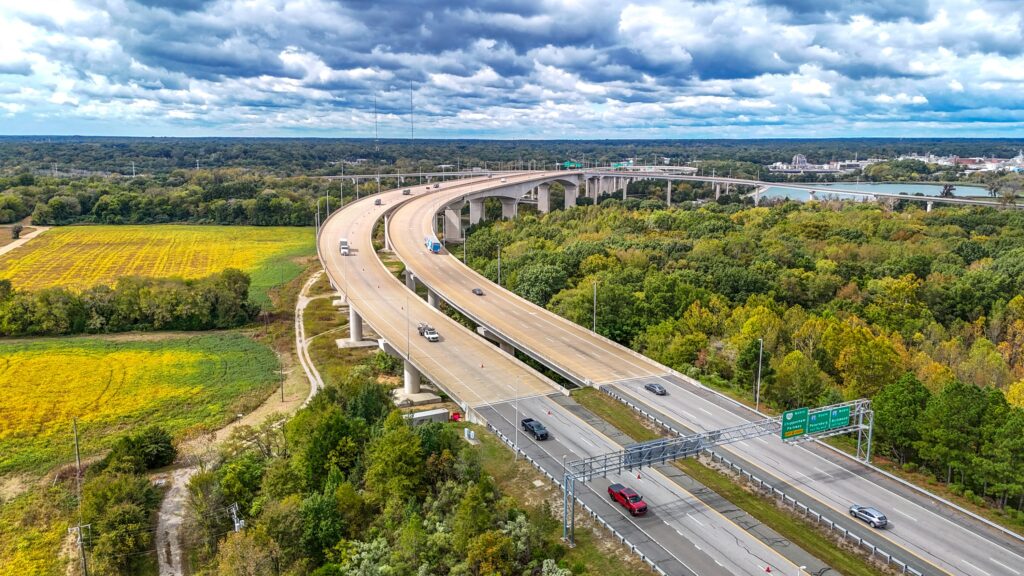
Pocahontas Parkway in Richmond, Virginia (USA).
Faced with this reality, an inevitable question arises: who is going to finance these investments?
For years, public debate has tended to oversimplify the issue by contrasting toll roads with free roads. However, this dichotomy is based on a mistaken premise. There is no such thing as a free road. All infrastructure entails costs associated with its construction, maintenance, modernization and operation. When a road does not have a user-payment system, its funding falls on taxpayers as a whole through public budgets, regardless of whether or not they use it. The difference is not whether the infrastructure costs money, but how that cost is distributed and who bears it.
This is precisely where the concession model becomes especially relevant. In a context of limited resources, public-private collaboration makes it possible to mobilize private financing to develop infrastructure without increasing pressure on public accounts. Under this framework, the Administration retains ownership and oversight of the infrastructure, while a private company assumes responsibility for financing, construction, operation and maintenance over a defined period. The result is a combination of capabilities that makes it possible to leverage the strengths of both sectors.
The main advantage of this model lies not only in financing. It also delivers efficiency. Unlike other management models, concessions require the private operator to think across the entire life cycle of the infrastructure. The party that designs and builds the road is usually the one that will have to maintain it for decades. This creates incentives to optimize costs from the outset, incorporate innovation, improve planning and ensure high standards of quality and safety. In addition, a significant share of financial, construction and operational risks is transferred to the concessionaire, reducing the Administration’s exposure.
But perhaps the most relevant contribution of the concession model is another one: its ability to free up public resources. Every euro of private investment mobilized for infrastructure is a euro that public administrations can allocate to other equally necessary priorities, such as healthcare, education, long-term care, housing or safety. In a context in which governments must respond simultaneously to challenges as diverse as the energy transition, defense and population ageing, this ability to complement public investment is particularly valuable.
In addition, the user-pays system incorporates an often-overlooked principle of equity. It allows those who use infrastructure to contribute directly to its funding, and those who generate greater impacts to bear a proportional share of those costs. This is not merely about raising revenue, but about creating mechanisms that support more efficient and sustainable mobility by encouraging behaviors that reduce congestion, emissions and infrastructure wear and tear.
Europe is entering a decisive decade for its competitiveness and for the modernization of its infrastructure. The real debate should no longer focus on whether roads should be financed through tolls or taxes. The underlying question is how to secure the investments our countries need without compromising the sustainability of public finances and without delaying the transformation of mobility. The data points to a clear conclusion: the investment gap is real, needs will continue to grow and public resources alone are unlikely to be sufficient. In this scenario, public-private collaboration and the concession model are not an exception or a temporary alternative; more than ever, they are a fundamental part of the solution.
Reference sources:
This article is based on the main conclusions of the ASECAP Manifesto 2026, “Protecting European Mobility: Fair, Resilient, Sustainable and Competitive through the Motorway Concession Model”.