
At Globalvia, we are taking a significant step towards advanced infrastructure management with the development of the digital twin of the Corgo Viaduct, located on our Transmontana concession in Portugal. This project, carried out in collaboration with WSP Spain, stems from a real need: to gain a more accurate understanding of the viaduct’s structural behaviour and to fully leverage the data it already generates.
Although the bridge has been equipped with sensors for years and we receive real-time monitoring data, until now it has not been possible to obtain real-time structural analysis. This is because structural analysis requires the simultaneous integration and correlation of measurements from all sensors in order to understand the viaduct’s overall behaviour. This process involves more prolonged and static data processing, which made real-time structural interpretation unfeasible.
The digital twin enables us to overcome this limitation by integrating different technological layers which, when combined, provide a level of detail and analysis that was previously much more difficult to achieve.
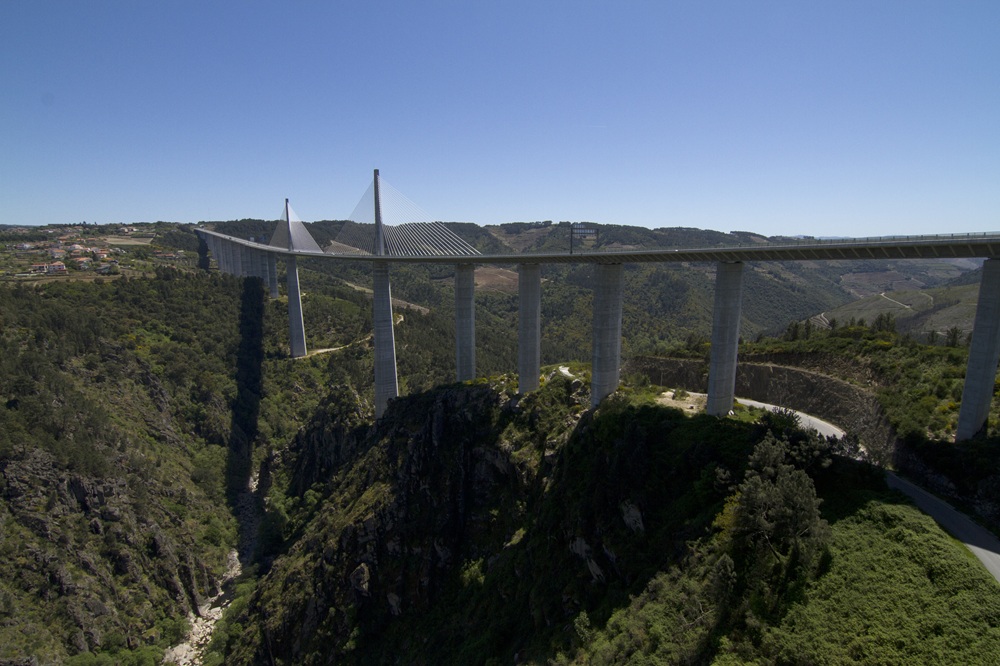
Corgo Viaduct on our Transmontana highway, in Portugal.
The core of the project is structural analysis, around which the different components are articulated:
-
A 3D BIM model that breaks down the viaduct into all its elements and allows inspections, documentation and asset condition to be linked.
-
A FEM structural model, currently under calibration, with a particular focus on thermal behaviour, which is key to explaining the movements observed in recent years.
-
A Machine Learning / AI model trained with real and synthetic data, capable of predicting behaviours that are not directly monitored and detecting potential anomalies.
-
An integrated interface that centralises all information and allows visualisation of the structural condition, generation of alerts and management of incidents.
A key aspect of the project is its integration with our asset management system, Geomic by Openvia, with the aim of enabling bidirectional communication between both platforms. This will allow the digital twin to send updated information directly to Geomic and, in turn, receive operational, maintenance and inspection data, strengthening a fully connected asset management approach.
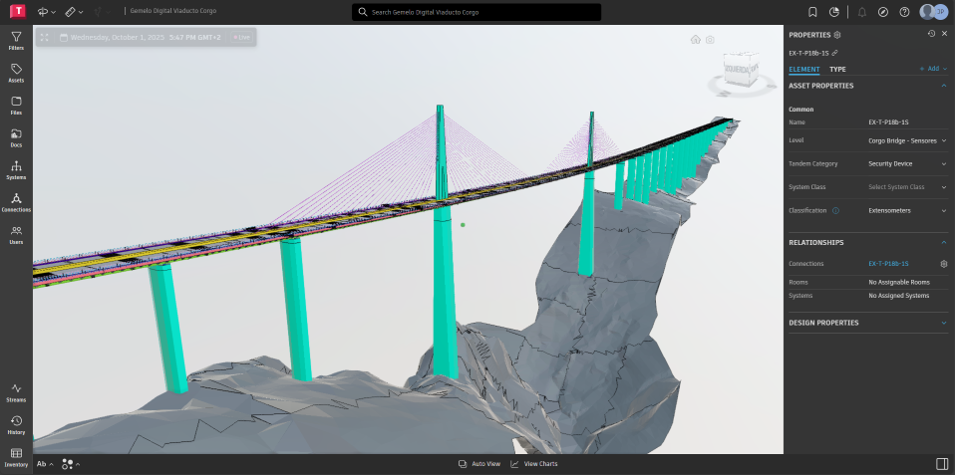
3D BIM model of the viaduct.
This is a pilot project, designed not only to address a real case at the Corgo Viaduct, but also to validate technologies that could be progressively extended to other assets in our portfolio, driving an intelligent, predictive and evidence-based asset management model.
The result is a system that integrates real-time data with advanced structural models, enabling more accurate predictive maintenance, early detection of anomalies and much more optimised intervention planning.